Stop Losing Shoppers to Bad Forms and Blind Spending
Stop losing shoppers to clunky forms, dead-end ‘thank you’ pages, and ad spend you can’t actually trace.
Simple tools, built for the person holding their phone.
Payment Estimator Tool
By far, the most used tool by shoppers is also where modern digital retailing creates major friction with complicated, hard-to-use software. Can you imagine asking a customer for their contact information before they complete the first step? What about requiring their social security number? How about asking the customer to sell themselves a backend product and generic accessories? Sound familiar?
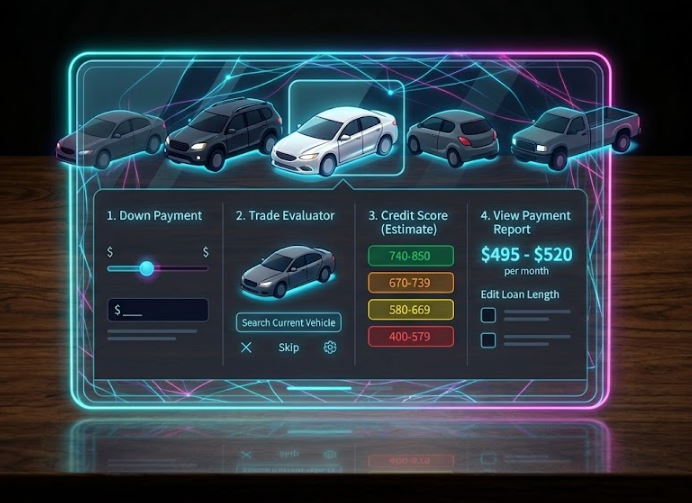
With Ride Match, a shopper picks a vehicle from your actual inventory, adjusts a down payment, and enters an estimated credit range — and gets a realistic monthly payment back immediately based on their credit score – then you get the lead. No jargon, dead-simple navigation, no guesswork about whether the number even applies to a car you have on the lot. Customers see approximate payment ranges to create flexibility in budgets. Conversion rates dramatically increase compared to OEM regulated digital retailing tools.
Step 1 – Down Payment
Step 2 – Trade Evaluator
Step 3 – Credit Score Estimate (No SSN or birthday required)
Step 4 – User Details & Payment Report
Trade Value Tool
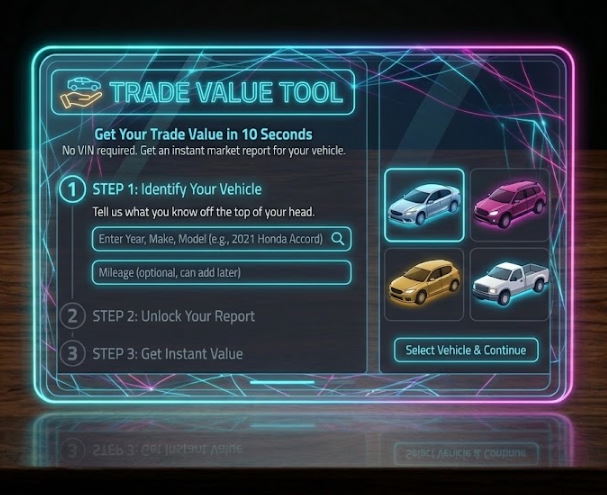
No VIN, no license plate, no photo uploads, no twenty-question condition survey. We ask what a shopper actually knows off the top of their head — year, make, and model — and that’s enough to generate a trade estimate. Mileage and any other details can be added later, at their own pace, after you already have the lead. Two steps, about 15 seconds, and you’ve got a trade report and a lead — not an unknown shopper who gave up halfway through. Trade values are open-ended putting the dealership in the driver’s seat to maximize profits.
Step 1 – Enter Year, Make, and Model
Step 2 – Add contact info to unlock the trade report
Step 3 – Get instant market value, research, and the option to add more details anytime
Budget-Based Inventory Search Tool
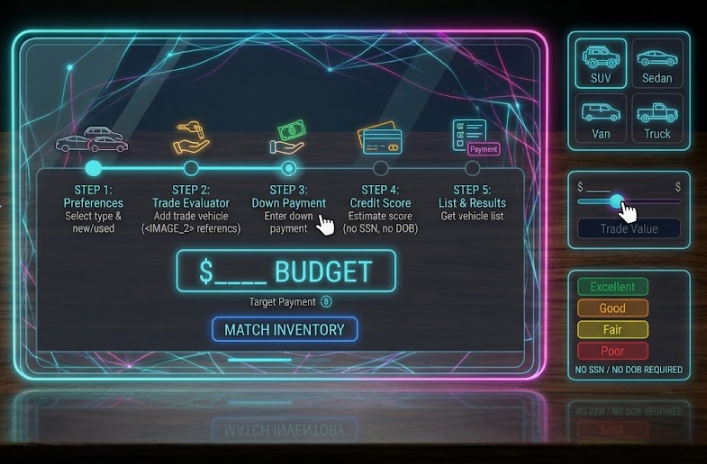
30% of website leads don’t start with a specific car in mind — often it’s a monthly payment they have in mind. This tool lets them enter a target payment or price along with basic preferences, and matches them to vehicles already in your inventory that fit. Without this tool, how many monthly budget oriented customers are you missing? 30%…the answer is 30%.
Step 1 – Select New and/or Used vehicle + vehicle type
Step 2 – Trade Evaluator
Step 3 – Down Payment
Step 4 – Credit Score Estimate (No SSN or birthday required)
Step 5 – User Details & List of Matching Vehicles
Unlock Your Price Tool
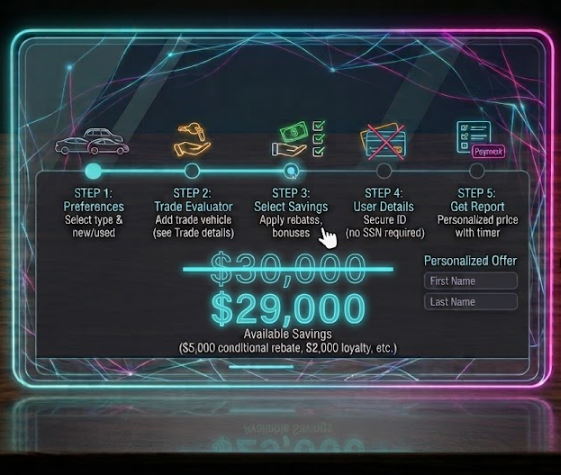
Manufacturer advertising rules (often called MAAP, or “Minimum Allowable Advertised Price” policies) limit what you’re allowed to show publicly on a vehicle listing — which is exactly why “click for our best price” exists on most dealership sites today, usually followed by silence. We instantly show your shopper their real, personalized price the moment they provide their information — along with any additional savings they may qualify for, conditional rebates, trade-in bonuses, or a loyalty discount. Because that price is shown one-to-one, after the shopper identifies themselves, it stays compliant while still giving them a real answer. Build urgency with default 72 hours expiration dates on offers. You can even provide extra discounts for customers in your competitor’s backyard 🙂
Step 1 – Select vehicle.
Step 2 – Select additional savings opportunities (optional)
Step 3 – User Details & Price report showing instant discounts.
How Do You Hold Your Marketing Spend Accountable?
As TV and radio budgets shrink, digital marketing keeps growing — so why does measuring it still feel like reading a vague local news report? Digital should be more trackable than that. It can be.

You’re trusting the platforms to grade their own homework.
Nearly all of Meta’s revenue (~97%) and most of Google’s (~73%) comes from ads. That alone is worth pausing on before trusting their reports to tell you honestly how well those ads worked.
Case in point: Meta doesn’t show you a list of who filled out your dealership website forms from their tracking pixel. It is their best estimate. The number includes both users who potentially clicked your ad and a guess, based on impressions and something Meta itself calls “modeled conversions.” Since 2021, Meta has honored browser App Tracking Transparency (ATT) settings, meaning it often doesn’t track real form submissions at all — it estimates how many you probably got using “modeled conversions”.
Facebook doesn’t show you the list of “leads” who filled out your website forms. They use “modeled conversions.”
Who does that benefit and did they clearly explain that to you?
“Events” in Google Analytics aren’t the same as answers.
GA4 gets treated as the source of truth, and it does report “events” — but that word is doing a lot of hiding. Every third-party form, chat tool, and widget on your site needs its own custom event stitched in separately, and that stitching breaks constantly as those tools get updated.
It’s also getting harder to trust, not easier. More manufacturers now require tracking-blocking scripts on dealer websites for privacy compliance — in one case we tracked, a manufacturer-required script cut a dealer’s GA4 visibility into their own website traffic by roughly 80%, overnight, with no warning.
And even when it is tracking, GA4 buries what matters under everything else it counts. A typical dealership account logs tens to hundreds of thousands of “events” a month — many of page_view or scrolls, not serious shoppers taking action. Ride Match only tracks the specific conversion events you define — a lead, a phone tap, a chat, a form fill — for every provider, on every page, independent of GA4 entirely and inclusive of all their multiple visits.


Last-click attribution doesn’t match how people actually shop.
Most platforms only give credit if someone converts in the same session they clicked from. So if a shopper clicks your TikTok ad, doesn’t convert, then comes back two weeks later through Google and submits a lead — TikTok gets zero credit. Google My Business gets the credit.
That’s not how people actually behave with any brand, car shopping included. Ride Match tracks the full journey instead of just the last step — so if TikTok and Google both played a part, both get the credit.
Ride Match uses multi-touch attribution to show you the entire shopping journey so that add click sources get credit for your leads and calls.
Here’s the only question that actually matters.
Did your paid clicks bring you real shopping intent?
A phone call link click that opens the dialer. A click that starts a chat. A lead that gets submitted. Those are conversion events — and they’re the only traffic worth paying for.
Here’s an example comparison of 2 campaigns. Your marketing partners are likely to show you astronomical impression counts, lowest cost-per-click, and massive click through rates. But does that matter if people aren’t emailing, calling, or chatting with you?
| Campaign A | Campaign B | |
| Spend | $12,000 | $4,000 |
| Call/Chat/Lead Events | 58 | 46 |
| Cost per conversion | $206 | $87 |
Stop measuring bounce rates and cost-per-click. Find out which campaigns are sending you real shoppers — and fire the ones that aren’t.
What drives us
Precision
We want accurate data we can trust. Not fluff.
Collaboration
Working with our dealer partners to execute on their campaign ideas and adding innovate features makes us all better.
Innovation
Consistently testing new ideas to improve performance across CTA’s and customer behavior.
Frequently asked questions
Are you compatible with all dealership website vendors?
Yes. It doesn’t matter if you are with DealerON, Dealer.com, Dealer Inspire, Dealer eProcess, or someone else. We can plug in to your existing website. We can track any custom lead event you request for marketing attribution.
What if I have custom terms I want to offer?
Our platform is already very agile to handle custom payment tables, trade values, inventory, and live website pricing tables. You are in control of what calculations and parameters that are offered to customers.
What does it take to get installed?
We send a simple install request email to your website provider using one line of code. You respond with approval.
What if I already have Digital Retailing tools required by the manufacturer?
This is not a problem. We can work with your website provider to organize your website layout so that your website stays in compliance without sacrificing for lower amounts of leads. In addition, most manufacturer programs only dictate rules about your Used Vehicle SRP’s & VDP’s.
Do you require long agreements?
We work with dealerships on a month-to-month basis and only require a 30 day notice to cancel. Our tools prove their efficacy every month.
Ready to get started?
Tell us about your project and let’s explore how we can bring your vision to life.